 |
|
Rate And Comment On This Charcoal: Click Here
Commentary
If you are concerned about destruction of rainforest or consumption of woods used by the local population for subsistence fuel, this information comes from CanaSAf:
When we opened the bag, we were pleased to see that the biggest issue with the previous version of this charcoal seems to be addressed. In our first review in December, 2004 we found that nearly 30-40% of each bag was unusable chips and dust. As you can see from the table below, this has been reduced to an exceptional 5.8%:
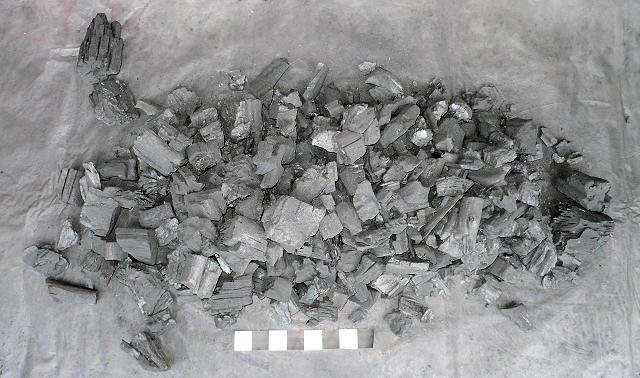
As you can see from the table and from the photo below, there still is no significant amount of large pieces of charcoal, but the amount of usable charcoal has increased dramatically. It appears to us that HardCoals is no longer putting the fines in the bag and the rest of the charcoal sizes have remained the same.
In sorting through the charcoal, we found no scrap and none of the plastic fiber that we found before. In general, the charcoal seems to be the same dense charcoal as before, but more care is being taken as to what makes it into the bag.
The charcoal took 5.5 sheets of newspaper to get started in our chimney starter test, which is higher than average but to be expected for such a hard dense charcoal. The smell of the charcoal is a fairly strong, bold, woodsy smell. similar to what we found in our first review. While burning in the chimney, there was some crackling noise but no significant sparking or popping. When lighting the charcoal with a MAPP torch we did note moderate sparking and popping, so as always, exercise care in using any type of torch to light charcoal.
In our maximum temperature test we were able to achieve a temperature of 1025 degrees, which is very high compared to other charcoals we have tested. There was very little sparking or popping while the charcoal was burning at high temperature. In our burntime test, the charcoal burned a relatively short period of time, low compared to other charcoals. The ash produced was high compared to other charcoals which was an improvement from our previous review where it was very high.
In our initial review, we noted some ammonia smells from the charcoal. As we reported then, we have noted this in various types of charcoal and don't really understand its origin. We can report, though, that we did not detect any such smells in this review. We conducted a taste test in our first review, the results of which we will repeat here:
To view reader ratings of all brands, Click Here.
Other Information
Unusual or Unique Statements
Statements From The Bag
Lighting Instructions
Photos Of Contents
This is the contents of the bag. Those are 1 inch squares on the measuring bar.
|
|
About This Review
If you are unfamiliar with our testing procedures, you may wish to read
How We Review Lump Charcoal before reading this review. Also, you can read
How We Score Lump Charcoal to learn about our scoring system.
Prices listed in our reviews are current as of the date of the review. We do not attempt to keep these prices current.
The conclusions and final rating given any charcoal are based upon the opinion of the author. We recommend that you use our rating only as a guide. You should read the entire review and decide what is important to you in making any buying decision.
Performance ratings are designated with stars, 1 star being the worst
and 5 stars being the best:
Images which can be viewed at a larger size have a small magnifying glass icon at the bottom right corner. Click on the icon to display the image in a new larger window. If you wish to ensure that you are seeing photographs the same way that we are seeing them, we recommend that you calibrate your monitor to a PC-normal gamma of 2.2. You should be able to see the difference between blocks A, B and C below, as well as the difference between blocks 3, 4 and 5.
This review is protected by Copyright and may not be reproduced in part or as a whole in any electronic or printed medium without prior permission from the author. You can use the "Email The Whiz" link at the bottom of any of our webpages to contact us about using material from this review.
|
You can support this website by shopping at The Naked Whiz Website Store and Amazon.com


 This charcoal comes to us from CanaSAf Traders, LTD, a Canadian company focused on bringing African products to North America. The have offices in
Vancouver and Calgary. The charcoal is presently available in the Vancouver area, but there are plans to expand. The charcoal is actually made in
Namibia. Where is Namibia? It is on the west coast of southern Africa, surrounded by South Africa, Botswana, Zambia and Angola. See the map at right.
This charcoal comes to us from CanaSAf Traders, LTD, a Canadian company focused on bringing African products to North America. The have offices in
Vancouver and Calgary. The charcoal is presently available in the Vancouver area, but there are plans to expand. The charcoal is actually made in
Namibia. Where is Namibia? It is on the west coast of southern Africa, surrounded by South Africa, Botswana, Zambia and Angola. See the map at right.
 This charcoal is made from four woods that we bet you haven't heard of before. We certainly haven't, which is understandable since we have never reviewed a product from Africa before. Here they are: